FDA Advisers Just Backed Four Peptides for Compounding. Here Is What That Actually Means.
On July 23, an FDA advisory committee voted to recommend four peptides for legal compounding, and it did so over the objection of the FDA's own scientists. It is a real turning point. It is also not the blanket FDA approval a lot of people are calling it. Here is exactly what happened, and what it changes for patients.
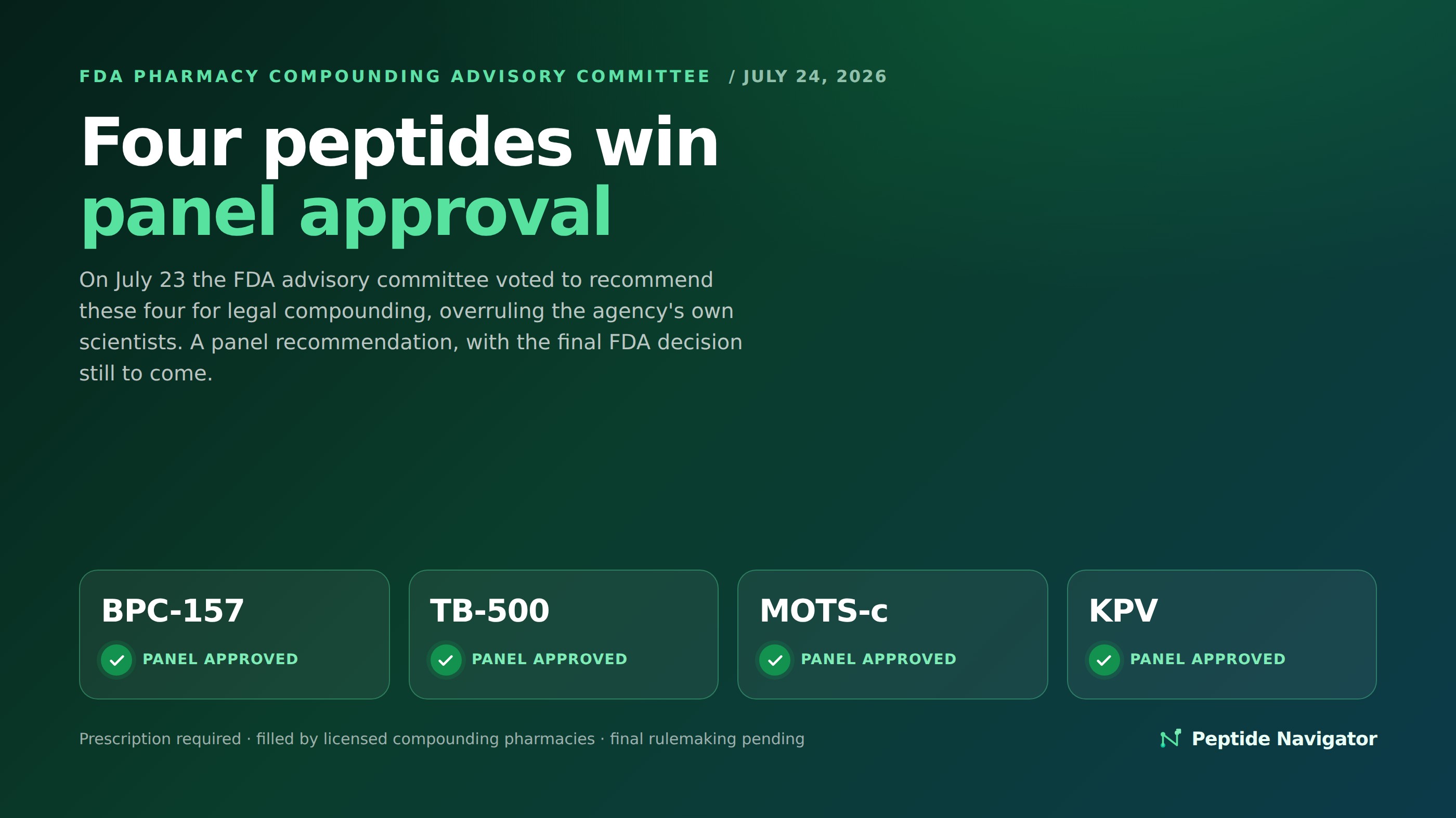
If you follow this space, your feed probably lit up on July 23 with some version of the same headline: the FDA approved BPC-157. That framing is exciting, and it is also not quite right. What actually happened is important enough that it deserves to be described accurately, because the difference between what the committee did and what people think it did will shape every decision a patient makes from here.
So let us walk through it plainly. What got voted on, what the vote does and does not do, how access would actually work, and the parts almost nobody is talking about yet.
Did the FDA approve BPC-157, TB-500, MOTS-c and KPV?
On July 23, 2026, the FDA's Pharmacy Compounding Advisory Committee voted to recommend that four peptides be added to the federal Section 503A Bulks List. That is the list of bulk ingredients that licensed compounding pharmacies are permitted to use when they prepare a custom medication for an individual patient. The four that got a favorable vote were BPC-157, KPV, TB-500, and MOTS-c.
Notice how narrow those margins are. This was not a room full of enthusiasts waving these through. It was a divided panel that landed, barely, on the side of yes. And the recommendation is nonbinding, which is the single most important thing to understand about the whole event.
A committee recommendation is advice to the FDA. It is not the FDA's final decision, and it is not drug approval. The panel voted yes. The agency still has to act before anything changes at the pharmacy level.
Recommended vs FDA approved: why the difference matters
An FDA-approved drug has been through a formal, years-long review. The agency examines the clinical trial data, the manufacturing controls, the purity, the safety profile, the effectiveness for a specific condition, the correct dosing, the labeling, and the overall balance of benefit against risk. None of that happened here.
The FDA itself is explicit that compounded drugs are not FDA-approved, and that it does not review compounded formulations for safety, effectiveness, or manufacturing quality before they reach a patient. So even if the FDA adopts this recommendation in full, these four peptides would still be unapproved compounded drugs. There would be no FDA-approved label, no FDA-established dose, no FDA-approved use, and no agency finding that the benefits outweigh the risks.
The honest one-line version is this. The advisory committee recommended allowing these substances to be used in patient-specific compounded medications. It did not approve the peptides as medications. Those are two very different sentences, and only one of them is true.
What each peptide was reviewed for
The committee did not evaluate these peptides for every use you see promoted online. It looked at specific nominated uses, and its vote applies to that narrow context, not to the broad menu of recovery, anti-aging, longevity, and performance claims that fill social media.
That distinction matters more than it looks. A favorable vote on BPC-157 for ulcerative colitis is not a green light for BPC-157 as a general tendon or gut healer, and the committee did not claim otherwise.
The FDA's own scientists said no. The panel overruled them.
Here is the part that makes this story genuinely unusual. Before the meeting, the FDA's own scientific reviewers recommended against adding all four substances. In their briefing documents, agency staff concluded that the available human evidence was too thin to establish adequate safety, effectiveness, chemical characterization, and quality control.
For BPC-157 specifically, the FDA reported limited and short human studies, a lack of adequate studies for several commonly used routes of administration, potential immunogenicity concerns, possible liver and clotting signals in animal studies, and three adverse-event reports, while noting that a cause could not be established. For KPV, MOTS-c, and TB-500, the agency said it had not found adequate human safety data for the proposed uses and routes.
The committee did not conclude that these four peptides are proven safe and effective. The majority essentially decided that regulated, prescription-based access may be better than leaving patients dependent on an uncontrolled gray market. That is a judgment about access, not a scientific stamp of approval.
It is also worth knowing that several panel members reportedly had professional or financial ties to peptide medicine, wellness clinics, telehealth, or compounding. Critics raised conflict-of-interest concerns, though HHS said the members cleared its ethics review. That does not invalidate the vote, but with margins this close and the agency's own staff on the other side, it is fair context to keep in mind.
How to legally get BPC-157 or TB-500 through a compounding pharmacy
Assume, for a moment, that the FDA does adopt these recommendations. What would getting one of these peptides actually look like? Not like grabbing a bottle off a shelf, and not like the anonymous checkout pages many people use today.
The likely path runs in a straight line. A patient sees a licensed prescriber and is evaluated the way they would be for any other concern. If that clinician decides a compounded peptide is medically appropriate, they write a patient-specific prescription. That prescription goes to a qualified compounding pharmacy rather than a retail counter. The pharmacy reviews it, prepares the formulation, quotes the patient a price, and, if the patient agrees, dispenses or ships it in line with federal and state law. From there, the clinician is responsible for monitoring.
The upside of this model is real. A licensed pharmacy operates under sourcing, testing, recordkeeping, and state regulatory requirements that an anonymous "research use only" website does not. It is a more accountable path. But it is not a guarantee of quality, because compounded products still skip the FDA premarket review that commercial drugs go through, and quality can vary from one pharmacy to the next.
A prescription does not make a therapy proven. It means a licensed clinician judged it appropriate for you and takes responsibility for that call. The evidence questions the FDA raised do not disappear because a script exists. This is a conversation to have with a clinician who knows your history, not a decision to make from a headline.
503A vs 503B: why mass supply is not here yet
There has been a lot of chatter about large compounding operations gearing up to ship enormous volumes. Some context helps here. This vote concerned the 503A Bulks List, and 503A is not designed as an unlimited mass-manufacturing pathway.
Section 503A pharmacies generally require a patient-specific prescription, are overseen mainly by state pharmacy boards, and face limits on interstate distribution and on mass-producing copies of commercial drugs. That is a different world from Section 503B outsourcing facilities, which can make certain products as office stock without an individual prescription, but which must register with the FDA and follow federal manufacturing standards. A favorable 503A vote does not automatically authorize 503B facilities to mass-produce these same peptides as general stock.
So when you read that a pharmacy has the capacity to scale production tenfold, treat that as capacity, not permission. Clean rooms and filling lines can be expanded quickly. The legal authority to ship these four peptides at scale still depends on final FDA policy, state law, sourcing rules, and the prescription requirement. Capacity is not the same as a green light.
Will CVS or Walgreens carry compounded peptides?
Most likely not in the way you pick up an ordinary prescription. Major retail pharmacies dispense finished commercial drugs. They do not generally prepare custom sterile peptide medications at the local store. The realistic model is a specialized compounding pharmacy that receives the prescription, prepares the formulation, and ships it to the patient, with a clinician managing care throughout.
Will insurance, Medicare or TRICARE cover peptides?
The idea that insurers will soon cover these is, for now, speculation. The July 23 vote did not create an FDA-approved use, a billing code tied to an approved product, an established price, a Medicare coverage decision, or a TRICARE formulary listing. None of the machinery that insurance runs on was set in motion.
Medicare Part D coverage of compounded products generally depends on whether the individual ingredients independently meet the definition of a covered drug, and an unapproved bulk peptide may not clear that bar. Broader coverage would likely require stronger human evidence, recognized uses, published treatment guidelines, consistent quality standards, and reliable pricing, and possibly an FDA-approved commercial product down the line. The defensible expectation is that access, at least at first, stays largely cash-pay.
Are BPC-157 and TB-500 banned in sports and the military?
A compounded prescription does not override anti-doping rules. BPC-157 and TB-500 have been tied to anti-doping prohibitions, and neither a physician's prescription nor a spot on the 503A list makes them permissible for Olympic, NCAA, or professional athletes, or for service members and others in safety-sensitive roles governed by their own performance-enhancing-drug policies. Medical legality, FDA regulatory status, and anti-doping eligibility are three separate questions. It is entirely possible for something to be legally compounded and still get you sanctioned in your sport or your unit.
Is the FDA peptide decision now up to RFK Jr.?
Not exactly. As HHS Secretary, Robert F. Kennedy Jr. has real policy influence over the FDA and has publicly supported wider peptide access, and this recommendation lines up with that stance, which makes favorable action more likely. But the formal decision runs through the FDA and HHS administrative process, involving agency leadership, lawyers, and regulatory staff, and potentially formal rulemaking. The advisory committee advises the FDA. It does not hand the matter to the Secretary for a personal yes or no.
When could these peptides actually be available?
The recommendation now goes back to FDA leadership, which will weigh the votes, the discussion, its own staff analyses, the public comments, and the legal criteria for the 503A list. A permanent addition to that list generally requires formal rulemaking, and history says that can take months or considerably longer. The FDA established its first 503A Bulks List through a final rule back in 2019, for reference on pace.
There is also a faster possibility. The FDA could issue an interim enforcement policy stating that it does not intend to act against qualifying pharmacies that compound these substances under set conditions while the formal process plays out. That would open access sooner, but it still would not amount to drug approval. Until the FDA takes one of these steps, the committee vote should not be read as nationwide permission to make or dispense these peptides.
Day 2: the July 24 votes on DSIP, Semax and Epitalon
The meeting continued on Friday, July 24, with reviews of Emideltide (also known as DSIP), Semax, and Epitalon, for nominated uses that included opioid withdrawal, insomnia, narcolepsy, cerebral ischemia, migraine, and trigeminal neuralgia. As of this writing, official results for those three votes had not been published. We are tracking them and will update our FDA Peptide Watch the moment they land.
Know each peptide, honestly
Our plain-English guides lay out what the evidence actually shows for BPC-157, TB-500, and more, caveats included, so you walk into that appointment informed rather than sold.
Browse the libraryBottom line: were four peptides really FDA approved?
This is a big moment, and it deserves to be treated like one. For the first time, an FDA advisory panel has said that four of the most talked-about peptides in the country should have a legal, pharmacy-based path, and it said so against the advice of the agency's own scientists. That is a genuine shift in direction.
But the accurate headline is that FDA advisers recommended a legal compounding pathway for four peptides, not that the FDA approved four peptides. The vote cleared an important hurdle. It did not settle the questions that matter most: the timing, the medical protocols, the quality standards, the insurance picture, and the long-term safety data. Watch for the FDA's actual decision, and remember that the safest route to any of these remains a licensed clinician and a licensed pharmacy, whatever the noise says this week.
Follow the story as it develops
We track every step of this process and update the moment the FDA acts. Explore our full library of evidence-first guides at peptidenav.com.
Sources and further reading
FDA, Pharmacy Compounding Advisory Committee meeting materials and briefing documents, July 23-24, 2026 (FDA.gov). Reporting on the July 23 votes and the FDA staff position: Reuters, WIRED, and AP News. FDA background on compounding and the Section 503A Bulks List (FDA.gov). Medicare Part D drug and formulary guidance (CMS.gov).
This article summarizes publicly reported information as of July 24, 2026 and is educational, not medical, legal, or financial advice. Many peptides discussed are not approved by the FDA for human use. Regulatory status can change quickly. Always consult a licensed healthcare professional before making any health decision.