Are Peptides Legal? The Honest 2026 Answer
"Are peptides legal?" has no single answer. It depends entirely on which peptide, and how it is used. Here is the honest 2026 map of the three categories that actually determine legality.
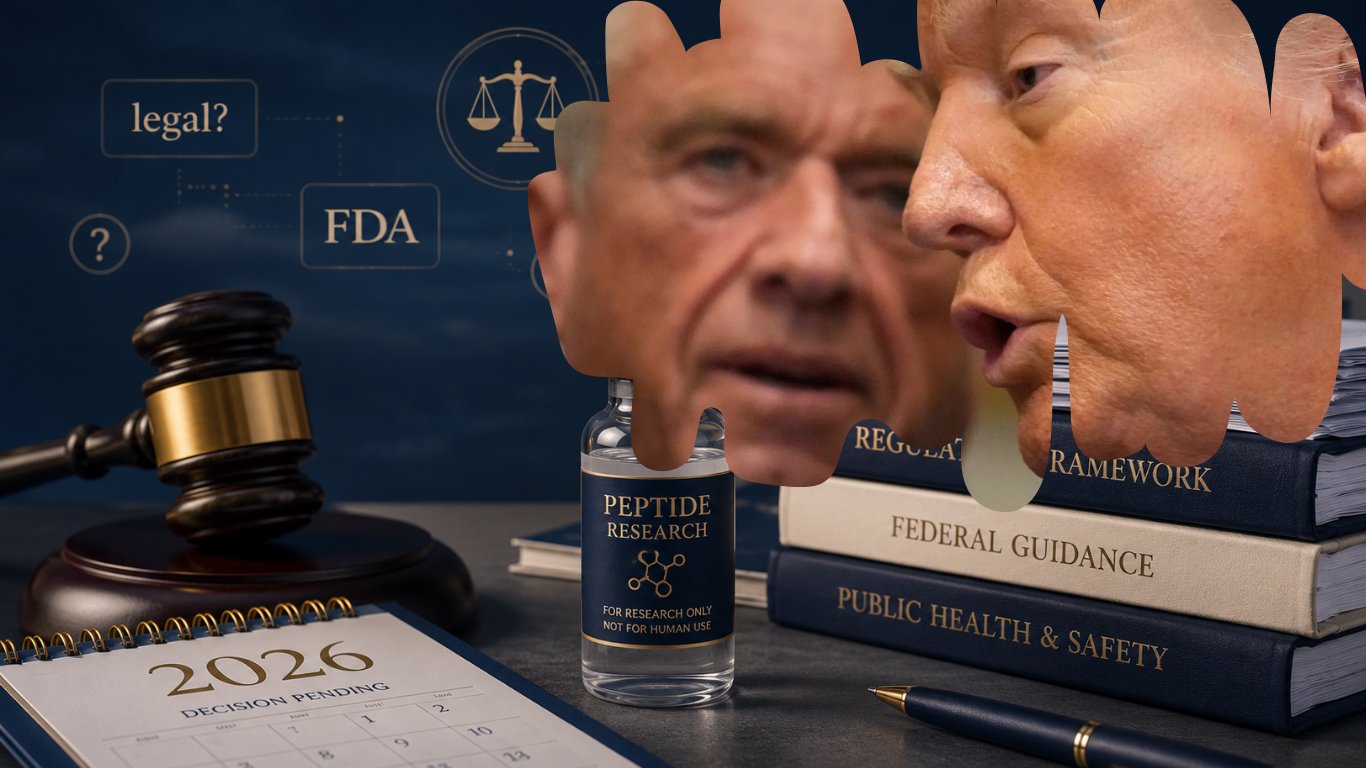
Few questions in this space cause more confusion than are peptides legal, and for good reason. "Peptides" is not one legal thing. The same word covers FDA-approved blockbuster drugs, prescription-only compounded therapies, and unregulated powders sold online with a "not for human use" sticker. Their legal status could not be more different. And right now, in 2026, the ground is moving under all of it.
Here is the honest map, the recent changes driven by the Trump administration and HHS Secretary Robert F. Kennedy Jr., the July FDA hearing that could reshape access, and where this whole thing appears to be heading.
The short answer: it depends which of three legal questions you are asking
Almost every argument online about whether a peptide is "legal" is really people talking past each other, because a single peptide can sit in three different legal lanes at once. A peptide can be banned in one lane and freely sold in another. Until you know which lane you mean, "is it legal" has no single answer.
Cleared through full clinical trials and a New Drug Application. Can be legally prescribed and sold as a finished medicine. Very few peptides clear this bar.
Prepared by a licensed compounding pharmacy for a patient with a valid prescription. Not FDA-approved as a finished drug. Governed by the FDA's bulk-substance categories, which is where 2026's changes are happening.
Sold "for research use only, not for human consumption." Legal to sell because the compound is unscheduled, but this is a legal status, not a permission slip to inject yourself. No pharmacy oversight, no verified quality.
The exact same peptide can be a legitimate prescription from a compounding pharmacy and, at the same time, a "research chemical" shipped by an online vendor. The molecule is identical. The legal reality depends entirely on the channel and the use, not the compound.
Are peptides controlled substances?
For most peptides people ask about, no. Compounds like BPC-157 and TB-500 are not scheduled under the federal Controlled Substances Act, which is why they can be sold "for research use only" without the compound itself being illegal to possess. That is very different from being legal to use as medicine. Unscheduled means the DEA does not treat it as a drug of abuse. It says nothing about whether the FDA allows it to be prescribed or sold for human use.
Separately, many performance-enhancing peptides are banned in sport by the World Anti-Doping Agency, so an athlete's "legal" question has an entirely different answer than a patient's.
What changed in 2023, and then in 2026
To understand today, you have to understand the whiplash. In late 2023, the FDA moved 19 widely used peptides to its Category 2 restricted list, effectively barring compounding pharmacies from preparing them. The stated rationale was safety: immunogenicity, manufacturing impurities, and thin human clinical data. Overnight, peptides that clinics had been prescribing vanished from legitimate pharmacy supply chains. Patient demand did not vanish with them; it shifted into the unregulated research-peptide market.
In 2026, the direction reversed, and the Trump administration drove it. On February 27, 2026, Health and Human Services Secretary Robert F. Kennedy Jr. publicly stated the intent to move roughly 14 of the 19 restricted peptides back toward legal compounding access. The stated goal was to restore a legal, physician-supervised pathway and pull patients back out of the gray market. The companies that had originally nominated the peptides for restriction withdrew their nominations, and on April 15, 2026 the FDA published the action, with the peptides coming off the Category 2 list effective April 22 to 23, 2026.
Coming off the restricted list is not the same as being cleared for compounding, and neither is the same as FDA approval. Removing a peptide from Category 2 erased the explicit "do not compound" strike. It did not automatically add it to the approved list. As of mid-2026, none of these peptides has completed the clinical trials required to become an approved drug. "No longer banned," "legal to compound," and "FDA-approved" are three different statements.
The July 23-24 hearing: what is actually being decided
On July 23 and 24, 2026, the FDA's Pharmacy Compounding Advisory Committee reviews seven peptides to recommend whether they should be added to the 503A list that licensed pharmacies can legally compound from. The committee makes a recommendation; it does not, by itself, approve anything.
What each outcome would mean
- A favorable recommendation puts a peptide on the clearest path it has had in years toward legal compounding. It still would not be FDA-approved, and formal rulemaking would still need to follow before things are settled.
- An unfavorable recommendation would likely stall access and keep the peptide in limbo, pushing more demand back toward the unregulated market.
- Either way, a committee recommendation is advisory. The FDA still has to act on it, and that process takes time. Nobody should read the hearing as an on/off switch for legality.
Even the best-case July outcome does not put a peptide on a pharmacy shelf the next morning. It moves it one step along a multi-stage road that runs well into 2027.
One peptide, two legal identities: form matters
A topical cosmetic form and an injectable form of the same peptide can have completely different legal status. Topical GHK-Cu, for example, is regulated as a cosmetic ingredient (Copper Tripeptide-1) and sits on shelves in serums today. Injectable GHK-Cu went through the Category 2 process entirely separately and is on the later review track. Same molecule, different lane, different rules.
Where this is heading
Strip away the noise and a clear direction emerges from the actual regulatory actions, not from anyone's opinion.
The 2026 moves, the withdrawn nominations, the Category 2 removals, and the scheduled reviews, all point the same way: toward reopening a legal, physician-supervised compounding pathway for peptides that spent three years locked out of it. The Trump administration and Secretary Kennedy have framed this as pulling patients out of the unregulated gray market and back into a system with prescriptions, licensed pharmacies, and quality oversight. Whether or not each specific peptide clears the bar, the trajectory of the policy is toward legitimizing access under supervision rather than banning it outright.
The counterweight is evidence. The same reviews that could open the door are also where the thin human data on many of these peptides gets scrutinized in public. A peptide can be politically favored for access and still struggle at a hearing if the clinical file is weak. That tension, growing demand and political will on one side, limited human trials on the other, is the real story of the next two years. Expect a staggered outcome: some peptides moving toward legitimate compounding, others staying stuck, and the gray market persisting in the gaps wherever legal access lags demand.
For the person actually trying to decide, the practical takeaway is stable even while the rules move: the safest, most legal path runs through a licensed clinician and pharmacy, and it is worth watching the hearings rather than the headlines.
We keep a live tracker of every peptide in the FDA review, updated as each decision lands. See where each one stands on our FDA Peptide Watch.
The honest bottom line
Is your peptide legal? The only correct answer is: it depends on which peptide, which form, and how you obtain and use it. FDA-approved drugs are legal with a prescription. Compounded peptides are legal when a licensed pharmacy prepares them for a valid prescription, and that pathway is actively reopening in 2026. Research-only powders are legal to sell but are not sanctioned for you to inject, and their quality is unverified. The landscape is genuinely in motion, which is exactly why legal status is something to confirm with a provider and pharmacy, not assume from a vendor's reassuring copy.
Read more and follow along
Explore the full library of evidence-first peptide guides, free articles, and our live FDA tracker at peptidenav.com. For the latest on the peptide reviews and what they mean:
Sources and further reading
FDA 503A Bulk Drug Substances list and Federal Register notice (April 2026); HHS Secretary announcement (February 27, 2026); FDA Pharmacy Compounding Advisory Committee July 23-24, 2026 agenda; Pharmacy Times (2026); reporting from Loti Labs, Newtropin, Peptadex, and AgeMD on the 2026 reclassification (2026).
This article summarizes publicly reported information as of July 2026 and is educational, not medical or legal advice. Regulatory and legal status can change quickly. Always consult a licensed healthcare professional and confirm current FDA guidance.