Testosterone and Peptides: Your Real Options in 2026
"Are peptides legal?" has no single answer. It depends entirely on which peptide, and how it is used. Here is the honest 2026 map of the three categories that actually determine legality.
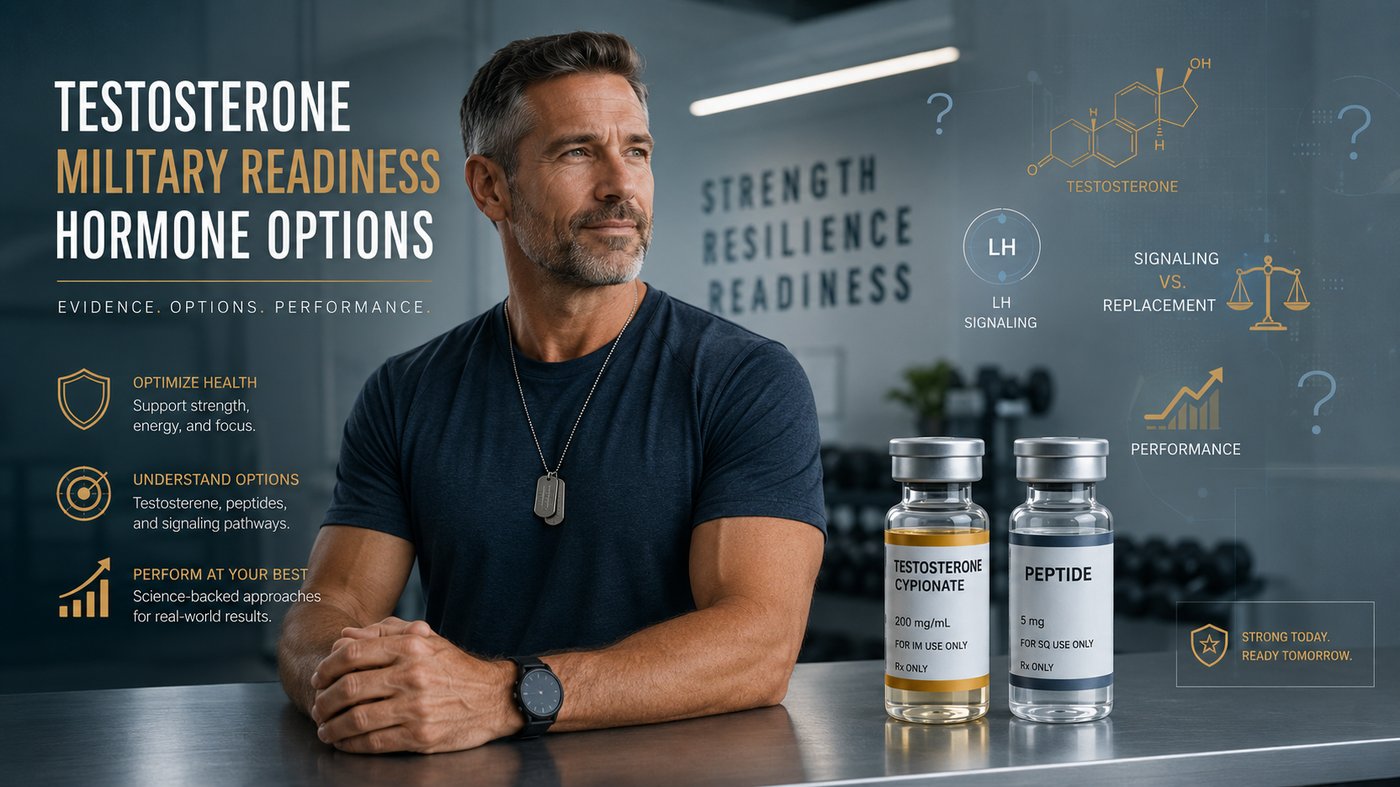
On July 15, 2026, Defense Secretary Pete Hegseth (@SecWar) announced that the Department of War will begin annual testosterone screening for service members 30 and older, added to the periodic health assessment, with troops under 30 able to opt in. Hegseth framed it in his announcement on X as being about readiness and optimization: "not about artificial enhancement," but "restoring and optimizing your natural capabilities."
Whatever you think of the policy, it moved a question that used to live in niche forums into mainstream conversation: if your testosterone is low, what are your actual options? Most people assume the answer is testosterone replacement therapy, or nothing. There is more to it than that. This is a plain-English look at how peptide-based approaches compare to traditional TRT, what the evidence actually shows, and what to watch for. It is educational information, not medical advice.
Two different strategies: replace it, or signal for more
Testosterone levels decline naturally with age, roughly one percent per year after 30 to 40, according to the Mayo Clinic. When levels drop enough to cause symptoms, there are two fundamentally different ways to respond, and understanding the difference is the whole ballgame.
Testosterone Replacement Therapy (TRT) delivers testosterone from the outside, through injections, gels, pellets, or patches. It reliably raises blood levels. The tradeoff is that supplying the hormone externally can signal your body to slow or shut down its own production, because the system that regulates testosterone works on feedback: when it senses plenty in the blood, it dials back its own output.
Peptide-based approaches take the opposite angle. Instead of replacing the hormone, they aim to stimulate the body's own production pathway, prompting it to make more testosterone naturally. They work by nudging the signaling chain rather than bypassing it.
TRT is like plugging in an external power source. Peptide signaling is like sending a message to your own generator telling it to run harder. One replaces. The other requests. They are not the same thing, and they do not fit the same person equally well.
Where each approach acts: the signaling chain
Your body makes testosterone through a chain of command called the HPG axis: the hypothalamus signals the pituitary, the pituitary signals the testes, the testes make testosterone. Each peptide discussed for testosterone support acts at a specific link in that chain. TRT skips the chain entirely.
The peptides people actually ask about
Three names come up most often. Here is what each one does, and what the human evidence honestly shows.
Kisspeptin-10
Kisspeptin acts at the very top of the chain, in the hypothalamus, increasing the pulses that ultimately drive testosterone. In a small, often-cited study, a continuous infusion of kisspeptin-10 raised testosterone meaningfully, on the order of a 40 to 45 percent increase. That sounds dramatic, and it is genuinely interesting, but the honest context matters: it was a tiny study (four men), delivered as a multi-hour intravenous infusion in a lab, not a real-world routine. And this is the crucial part, stimulating the upstream signal does not guarantee testosterone actually rises. If the testes cannot respond well, the downstream effect can be modest or minimal. Responses vary widely from person to person. Kisspeptin is a signaling stimulator, not a guaranteed testosterone button.
Gonadorelin
Gonadorelin is a synthetic form of GnRH, the signal the hypothalamus normally sends. It acts one step down, directly prompting the pituitary to release LH and FSH. Because it keeps the fuller hormonal cascade active, it is sometimes used in clinical settings related to fertility and to certain forms of low testosterone where the goal is to keep the body's own machinery running rather than override it.
CJC-1295 and Ipamorelin
This common pairing does not directly raise testosterone at all. Both are growth-hormone secretagogues, they support the growth hormone and IGF-1 pathways. People use them as an add-on for recovery, sleep, and body composition, which can indirectly support an environment where hormones function better, but it is important to be clear: they are not testosterone drugs. Filing them under "testosterone peptides" is a common misunderstanding.
Most peptides discussed for hormone support are not FDA-approved for this use. Results vary widely with age, baseline levels, lifestyle, and the root cause of low testosterone. And product quality and sourcing matter enormously, the gray market carries real risks. None of this is a do-it-yourself project.
Peptides vs TRT: a practical comparison
In practice, some clinicians combine approaches, for example using TRT alongside peptides that support other pathways, but that is a decision that requires medical oversight and real bloodwork, not a self-directed experiment.
A note on the screening news, and balance
The renewed attention is a genuine opportunity for people to understand their options. It is also worth knowing that this is a debated area. Major medical bodies, including the American Urological Association, generally recommend against routine testosterone screening in the broad male population, and physicians have urged that any large screening program use clear, evidence-based guidelines so the goal is appropriate diagnosis and treatment rather than simply putting more people on hormones. That is not a criticism of anyone, it is exactly the kind of context that lets you ask better questions. The right answer for you depends on your own labs, symptoms, and a clinician's assessment, not on a headline.
The bottom line
If your testosterone is low, you have more than one path. TRT reliably replaces the hormone and is the established choice for genuine clinical deficiency. Peptide approaches like kisspeptin or gonadorelin take an upstream route, prompting your body's own production, which can appeal to those focused on optimization or preserving fertility, though the human evidence is earlier and the results more variable. Neither is a magic switch, and both belong in a conversation with a knowledgeable clinician who has run comprehensive bloodwork.
And before any of it: the fundamentals still do the heaviest lifting. Sleep, training, nutrition, and stress management move testosterone more reliably, and more safely, than most people expect. Optimize those first. Then have the informed conversation.
Read more and follow along
Explore the full library of evidence-first peptide guides and our live FDA tracker at peptidenav.com. For the latest on peptides, hormones, and what the research actually shows:
Sources and further reading
Department of War / Defense Secretary Pete Hegseth announcement on annual testosterone screening (July 15, 2026), as reported by CNN, NBC News, The Hill, and CBS News. George et al., "Kisspeptin-10 Is a Potent Stimulator of LH and Increases Pulse Frequency in Men," Journal of Clinical Endocrinology & Metabolism (2011). Mayo Clinic on age-related testosterone decline. American Urological Association guidance on testosterone screening.
This article summarizes publicly reported information as of July 2026 and is educational, not medical advice. Regulatory status and evidence evolve. Always consult a licensed healthcare professional, get comprehensive bloodwork, and verify the legality and sourcing of any compound in your situation.