Know your source: this is your body
A peptide poster in a corner-store window, selling injectable drugs next to the energy drinks, tells you everything you need to know about the gray market. "Research use only" is a legal shield, not a safety guarantee. When it comes to what you put in your body, cheap is not the same as smart.
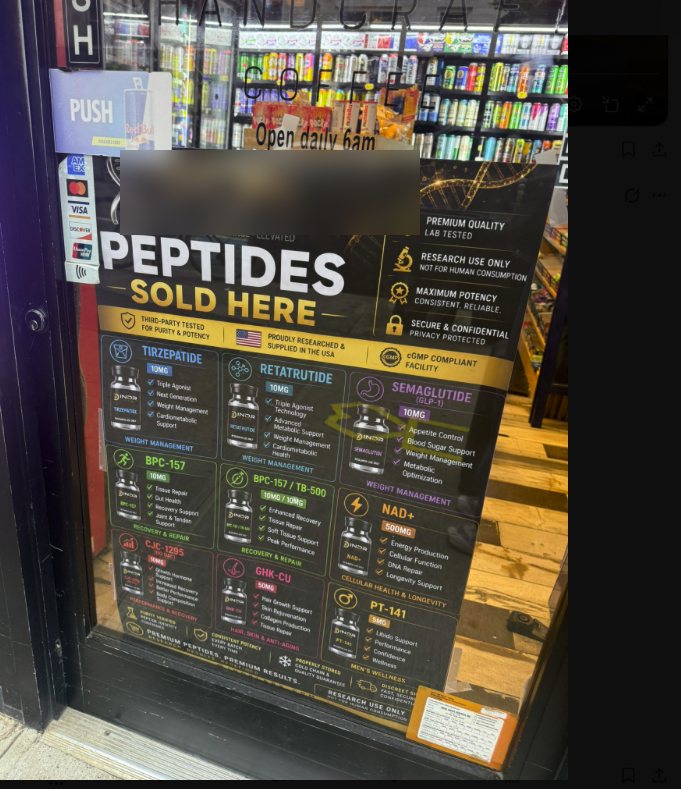
There is a photo that captures the peptide gray market better than any statistic could: a glossy poster taped inside a corner-store window. "PEPTIDES SOLD HERE." Tirzepatide, semaglutide, BPC-157, TB-500, listed like lottery tickets, with little shields promising "premium quality" and "lab tested." And down in the corner, the phrase that does all the legal work: "research use only, not for human consumption."
Sold in a shop that also sells cigarettes and scratch-offs. That is the reality this article is about.
"Research use only" is a loophole, not a promise
That four-word disclaimer is not there to protect you. It is there to protect the seller. For years, vendors sold powerful compounds by putting "not for human consumption" on the vial, which let them argue they were selling research chemicals, not drugs. The label was always a thin legal shield, never a statement about quality or safety.
And in 2026, that shield is collapsing. Early in the year, the proposed SAFE Drugs Act took direct aim at the model, seeking to prohibit the sale of research chemicals biologically identical to FDA-approved drugs without going through the approval process. The FDA escalated from warning letters to warehouse raids. The Department of Justice moved past civil penalties to criminal prosecutions, securing guilty pleas from people running these operations.
The market is imploding, and that is the tell
If the gray market were as safe and reliable as its marketing suggests, it would not be vanishing. But it is.
On March 6, 2026, the largest gray-market research peptide vendor in the United States, doing an estimated 7.4 million dollars in sales in December 2025 alone, posted a three-sentence notice and went dark the same day. No warning. No refunds. No guidance for customers with pending orders. It was not alone. More vendors shut down between mid-2025 and early 2026 than in the previous five years combined. Over 50 FDA warning letters went out. At least one vendor operator pleaded guilty to federal charges after investigators found products labeled as one thing that actually contained another.
Build a health routine around a supplier, and one afternoon the website is a dead link, your money is gone, and there is no one to call. That fragility is the structural condition of an unregulated market, not a rare accident.
What you cannot see, and cannot verify
Here is the part that should stop anyone considering a cheap vial. The World Health Organization estimates that roughly one in ten medical products in low- and middle-income markets is substandard or falsified, and it is explicit that such products can cause serious illness or death. Quality failures concentrate wherever regulatory control, testing, and enforcement are weak.
That is the risk you quietly inherit when you buy from a supply chain with no referee. An unregulated peptide vial typically has no verifiable country of origin and no accountable manufacturing standard. You cannot see the purity. You cannot see the sterility. A vial of the real compound and a vial of something else look identical. When independent labs tested gray-market products, they did not just find weak ones, they found contamination, counterfeits, incorrect dosing, and in one case an outright counterfeit: a fundamentally different substance sold under a known name.
Why cheap is the most expensive choice
The appeal of the gray market is obvious: it is cheaper and easier than a doctor. But run the actual math on what "cheap" is buying. You are paying less for a product with no verified identity, no verified purity, no sterility validation, no dosing standard, and no one accountable if it harms you.
The savings are real. The thing you are saving money on is the entire quality and safety infrastructure. That is not a discount, it is removing the guardrails and pocketing the difference. A cheap price often reflects exactly the skipped controls that the data ties to harm. This is your body, not a research sample, and it is the one system you cannot replace.
This five-point summary is the short version. The complete framework, a full source red-flag checklist, and a plain-English guide to reading a certificate of analysis so you can tell a real one from a hollow one, is a standard chapter in the BPC-157 guide. That same source-verification standard runs through every Peptide Navigator guide we publish. It is the same discipline, applied to every peptide.
The bottom line
The gray market is not a clever life hack. It is a legal gray zone that is actively collapsing under enforcement, and it was never built to protect the person swallowing or injecting the product. "Research use only" means exactly what it says: this was never meant for you.
Do your research. Know your source. And when the choice is between cheap and your body, choose your body. The right question is never simply what is the cheapest way to get this. It is what am I actually buying, what was verified, and who is accountable if it is wrong. Those questions point, every time, toward a licensed professional. Toward a provider, never around one.
BPC-157: The Recovery Peptide Guide
The full source red-flag checklist and the how-to on reading a certificate of analysis are in the BPC-157 guide, the same verification standard built into every Peptide Navigator guide.
Browse the librarySources and further reading
WHO substandard and falsified medical products estimates (analysis of 48,000+ samples across 88 countries); Pharmacy Times (2026); PeptideLaws.com enforcement timeline (2026); The Peptide Catalog vendor shutdown tracking (2026).
This article summarizes publicly reported information as of July 2026 and is educational, not medical or legal advice. Regulatory status and evidence can change.